
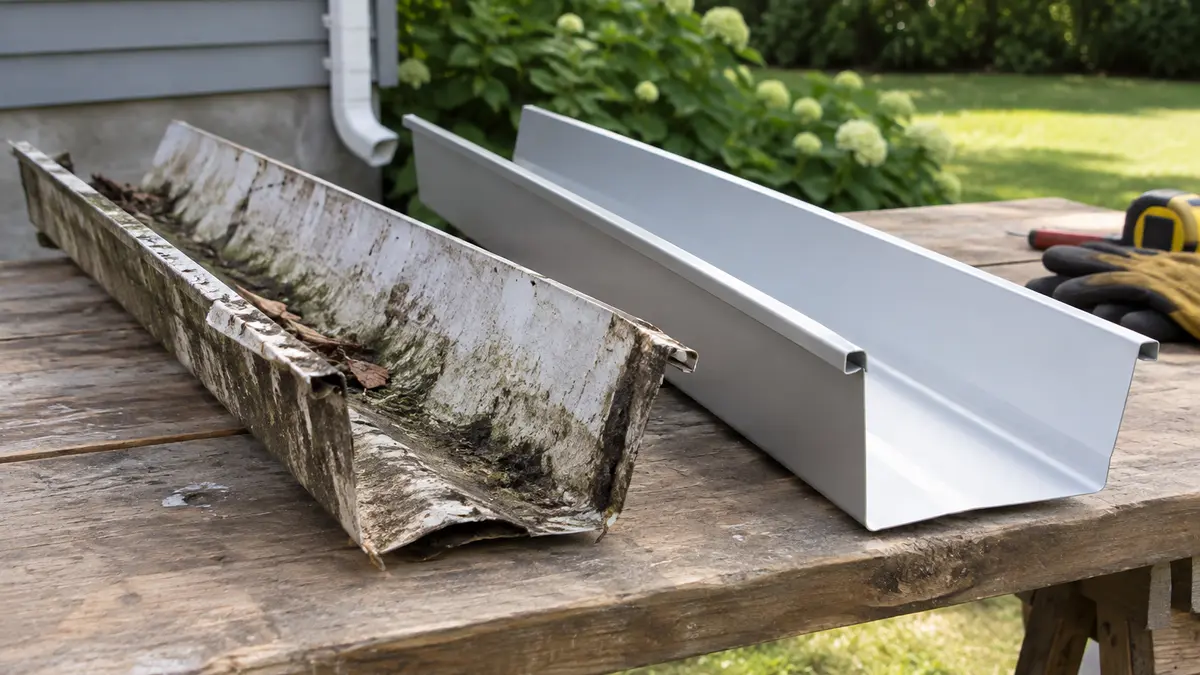
Begin with the extent of failure
One failed component does not automatically condemn an entire system—and one visible leak may not be the only problem.
Map each symptom by elevation. A single leaking outside corner, one damaged outlet or a few loose hangers can be a focused repair. Multiple low sections, recurring corner failures and several distorted runs suggest that individual patches may not restore a coherent system.
Check the metal and profile compatibility
A repair needs enough sound material to clean, refasten, reseal or join. Older profiles, colours and dimensions may be difficult to integrate neatly. Broad corrosion, splitting or deformation reduces the value of attaching new components to the remaining run.
Do not ignore the fastening surface
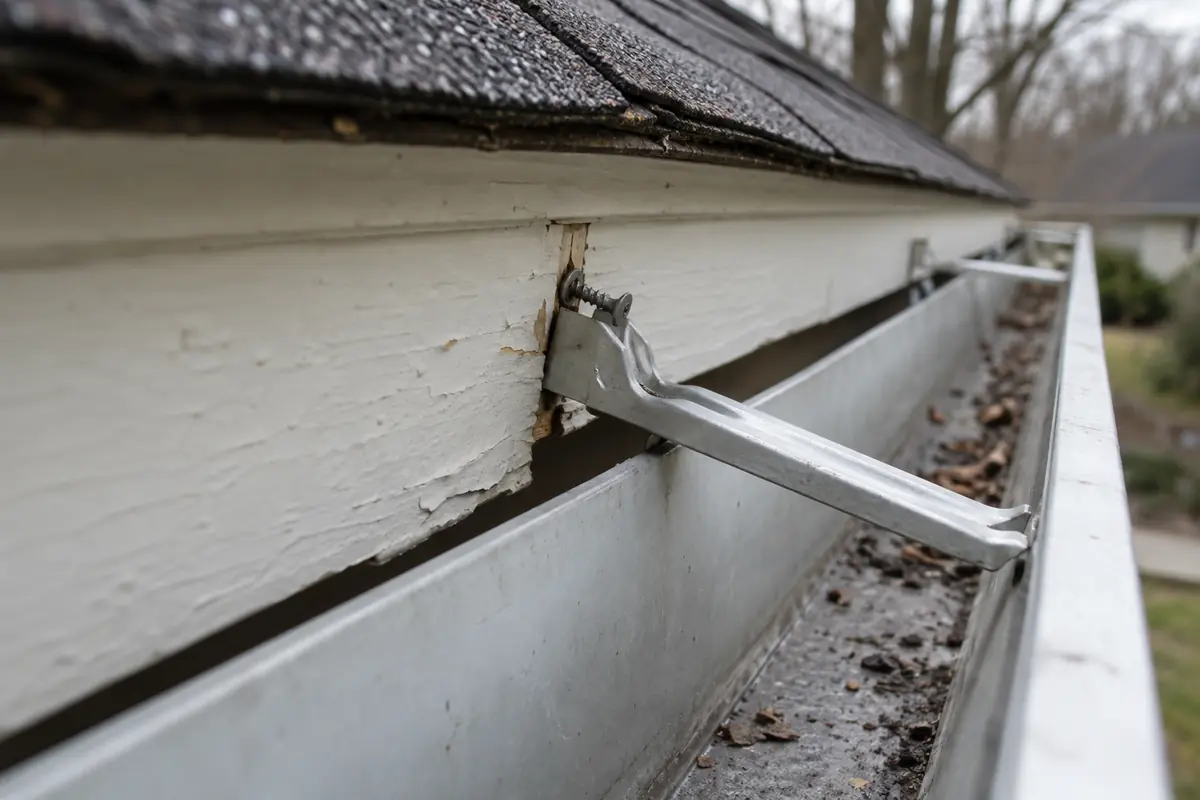
A new hanger is useful only when it can fasten into a suitable roof-edge assembly.
If fascia is soft, split, displaced or concealed by questionable capping, a gutter-only repair may not hold. Determine whether localized carpentry or coordinated soffit and fascia work is needed first.
Compare slope and capacity
A watertight patch does not correct a long run that drains poorly or lacks adequate outlets. Repeated overflow can reflect layout or sizing rather than joint failure. If the basic system is unsuitable for the roof area or concentrated valleys, replacement or partial redesign may deliver more value than repeated sealing.
Consider related future work
Roofing, soffit, fascia, siding or painting projects may require removal or disturb the roof edge. Coordinating timelines can prevent paying to repair a run that will soon be removed. Conversely, a sound system should not be replaced merely because another exterior project is nearby.
Compare repair and replacement signals
| Repair is often reasonable | Replacement deserves review |
|---|---|
| One defined leaking joint | Several recurring joint failures |
| Small number of loose hangers on sound fascia | Widespread pull-away or unsuitable support |
| One damaged outlet, elbow or short section | Incompatible components or broad deformation |
| Capacity and layout otherwise work | Overflow continues because layout or capacity is unsuitable |
| No near-term roof-edge renovation | Related work will require removal |
Evaluate cost as scope, not just price
A lower initial repair price can be sensible when it addresses the actual failure. It is less useful when access, setup and repeated callbacks accumulate across a broadly failing system. A replacement price should clearly state which elevations, outlets, downspouts, removal and related finishes are included.
Prepare the decision with evidence
- List each leak, sag, separation and overflow location.
- Show wide views of every affected elevation.
- Note previous repairs and how long they lasted.
- Show fascia and soffit around loose sections.
- Describe future roofing or exterior plans.
- Ask which parts can remain and why.
Compare options over a realistic planning period
A focused repair can be the responsible choice when it restores a sound run and the surrounding system is likely to remain useful. Replacement may offer better value when repeated setup and access costs are being paid for new failures on the same elevation. The comparison should use the known condition and likely next work—not a generic claim that new is always better.
Ask for reasons, not only two prices
A repair option should identify the failed component and why adjacent material can remain. A replacement option should explain which broader condition it corrects, what connected components are included and whether the layout changes. Without that rationale, two totals are not a meaningful decision guide.
Questions about this service
How old is too old to repair?
Age alone is not decisive. Metal condition, profile compatibility, fastening, slope and the extent of failures matter more.
Can one run be replaced while others remain?
Yes, when the remaining elevations are serviceable and the transition, colour, outlets and downspout layout can be coordinated.
Is resealing every corner normal maintenance?
Joints can require service over time, but repeated failures may indicate movement, preparation, deformation or broader system conditions.
Should fascia be replaced with the eavestrough?
Only where its condition or the planned finish requires it. Sound fascia does not need replacement simply because the trough is being changed.
Can repair and replacement be combined?
Yes. One elevation may need replacement while a sound section elsewhere only needs a defined repair, provided the scope keeps each decision clear.