
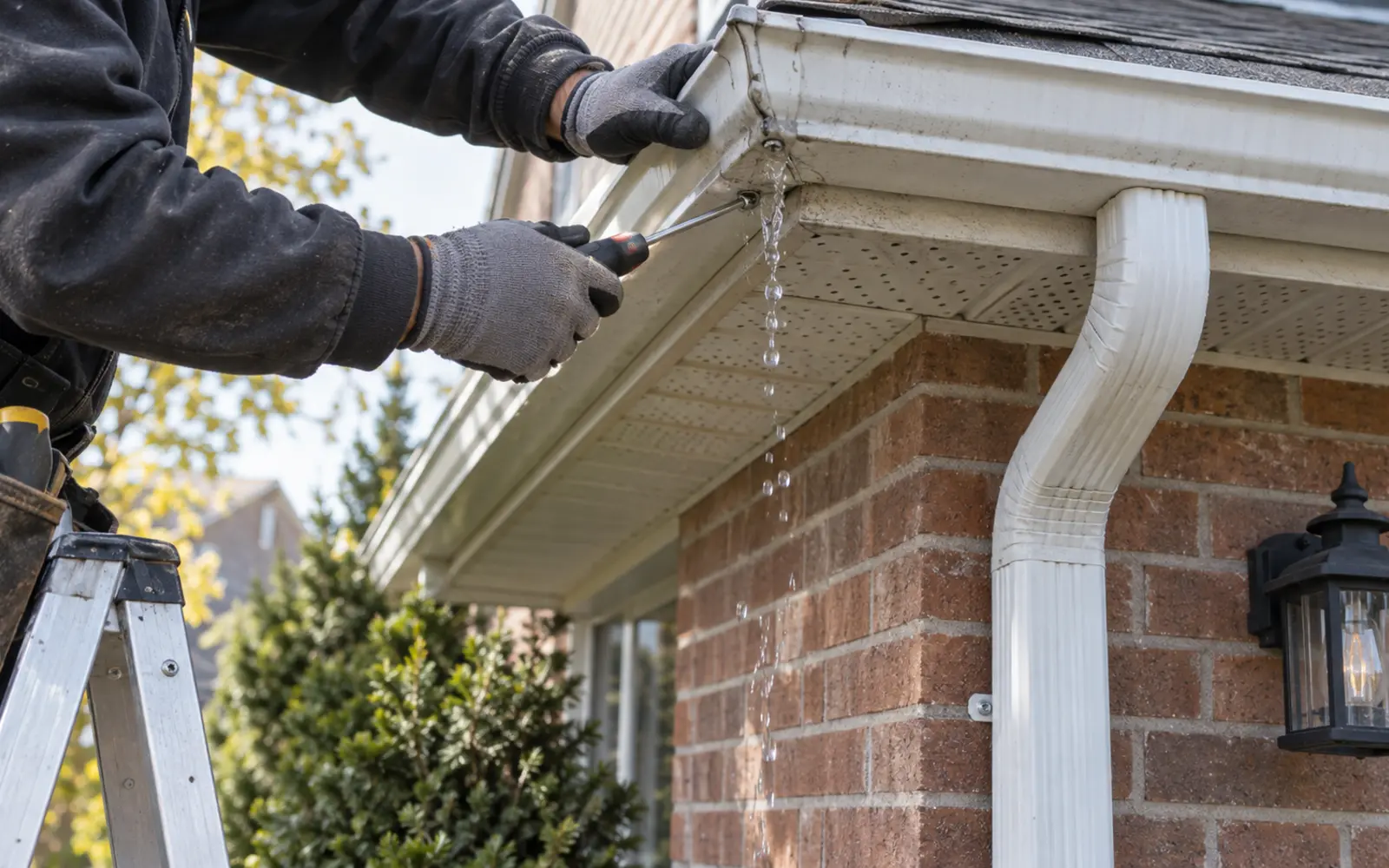
Common repair conditions
- Water escaping from an outside or inside corner.
- A run pulling away from fascia or dipping between fasteners.
- An outlet connection leaking or separating.
- A crushed, split or disconnected downspout component.
- A short damaged section beside otherwise serviceable material.
- End-cap or transition leakage.
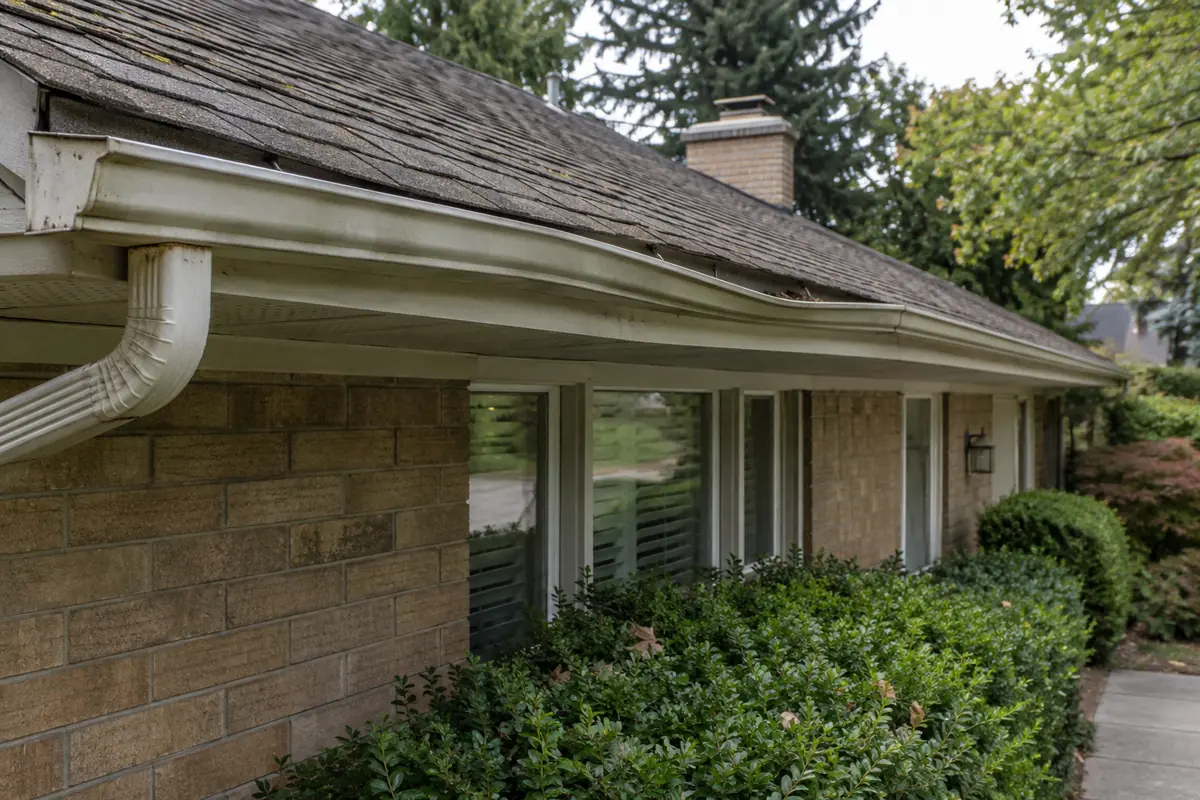
Why an eavestrough sags
Sag is a condition, not a single diagnosis.
Possible contributors include loose or widely spaced hangers, a weakened fascia fastening surface, deformation from ice or impact, retained debris and a slope that was never set correctly. Fastening new hardware into deteriorated wood does not resolve the support problem.
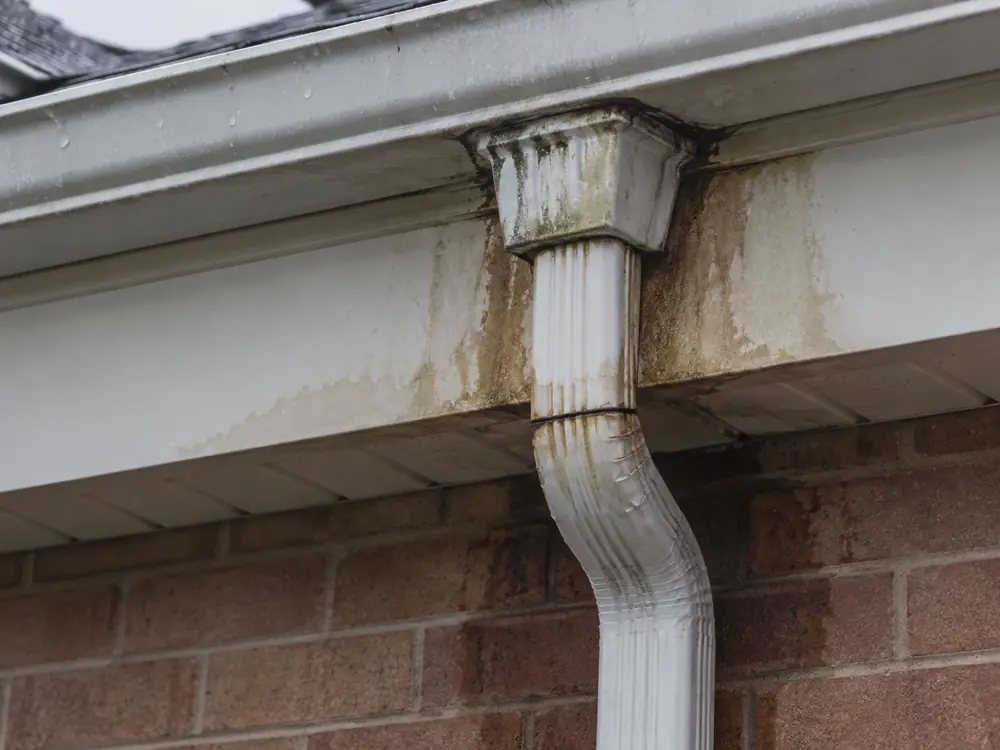
Leaks at corners and outlets
Corners and outlets are natural service points because they contain seams, sealants and openings. A repair should address cleanliness, fit, movement and the surrounding metal—not simply place material over a wet or contaminated surface.
Repair or replace?
Compare the extent of failure with the condition of the full system.
Use the detailed repair-versus-replacement guide to prepare your questions.
| Repair may fit when | Replacement may fit when |
|---|---|
| One corner or end cap leaks | Multiple joints repeatedly fail |
| A few hangers are loose and fascia is sound | Long runs pull away or fascia support is broadly poor |
| One outlet or elbow is damaged | Layout or capacity is unsuitable across the elevation |
| A compatible short section can be integrated | Profile, colour or condition makes patching impractical |
What repair does not cover
Cleaning alone is a separate maintenance task. Rot repair, structural roof work, masonry waterproofing and underground drainage are also separate scopes. A visible leak can sometimes originate above the eavestrough, so the observed water path matters.
Photos that help assess a repair request
- A wide view showing the entire affected elevation.
- A closer view of the corner, joint, fastener or outlet.
- A photo taken after rain showing staining or the water path.
- The fascia and soffit directly around the affected area.
- The downspout route when overflow occurs near an outlet.
Use rain behaviour to distinguish the failure
Water dripping from the bottom of a corner after the trough fills suggests a different condition from water running behind the fascia immediately or jumping past the front below a roof valley. Staining can mark the destination without identifying the origin, so the connected roof edge and outlet still need review.
A short ground-level video during safe rainfall can show timing and direction. Combine it with dry-condition photos of the full elevation, because an extreme close-up often hides slope, valley position and the distance to the downspout.
Understand the durability limit of a localized repair
A repair can restore a sound system, but it cannot make brittle, heavily distorted or incompatible material new. The scope should identify why the repair is reasonable now and which surrounding conditions could shorten its useful life. That explanation is more valuable than a blanket promise or an automatic recommendation to replace everything.
A defined process from observation to closeout
Locate the symptom
Identify the exact joint, run, outlet or downspout and when the problem occurs.
Check connected conditions
Review surrounding metal, slope, attachment, fascia and the nearest outlet.
Compare repair with replacement
Decide whether a focused correction can restore reliable service.
Complete the approved repair
Prepare and correct the defined component without hiding broader damage.
Review the water path
Confirm the repair location and note any separate maintenance or drainage issue.
Useful details for an estimate
Ground-level information helps identify the right property, location, access plan and likely scope before the next conversation.
- Wide and close ground-level photos
- Exact leak, sag or separation location
- When the problem occurs
- Previous repairs and cleaning history
- Nearest outlet, downspout and discharge point
Safety: Do not climb a ladder to collect photos or measurements.
Questions about this service
Can a leaking corner be resealed?
Often, when the metal is serviceable and the joint can be properly prepared. Movement, distortion or repeated failure can require rebuilding the corner or broader replacement.
Will adding more screws fix a sag?
Only if the fastening surface is sound and the hanger layout is the actual cause. Fascia deterioration, deformation and poor slope must also be considered.
Can one eavestrough section be replaced?
Sometimes. Profile, dimensions, colour, joint location and the condition of adjacent material determine whether a short integration is practical.
Why does a repaired leak return?
The original surface may not have been prepared, the joint may still move, or a broader slope, support or capacity problem may be loading the same location.
What information helps distinguish a leak from overflow?
Note whether water passes through a joint, travels behind the trough, overshoots the edge or rises over the front, and show the nearest outlet and roof valley.